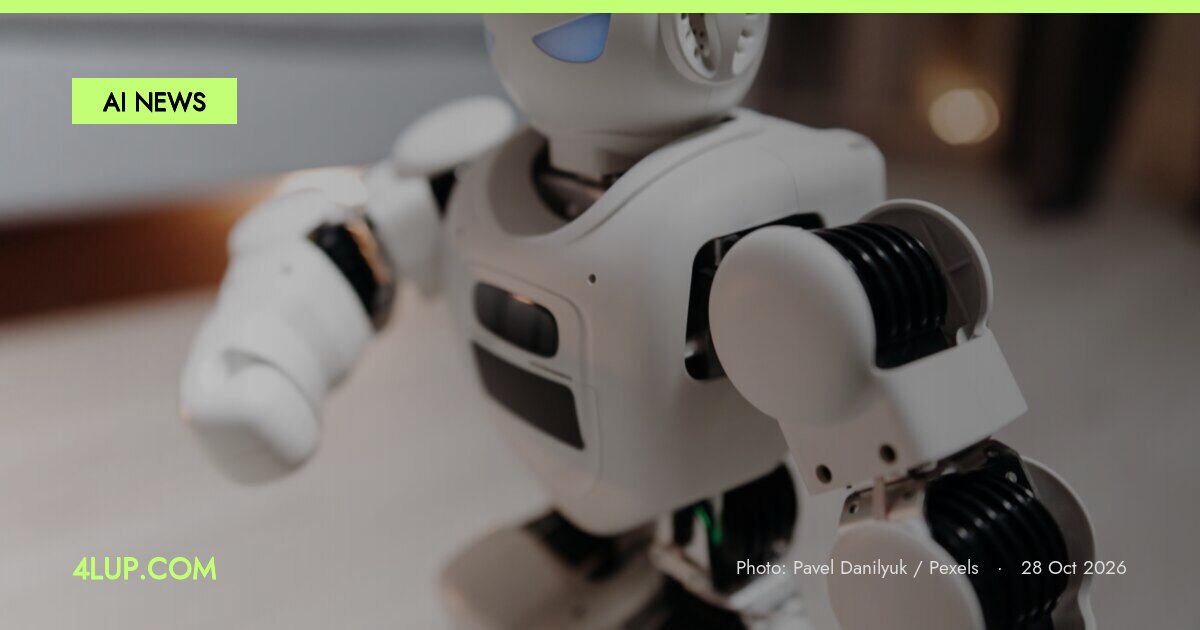
Researchers have detailed a new Vision-Language-Action learning framework called ThinkWorld, according to a report published by arXiv cs.AI. The approach attempts to tackle a primary limitation in robotic manipulation: the reliance on action-labeled robot demonstrations, which often lack the diversity and coverage needed for robust real-world generalization. While human video offers a wider array of behavioral and environmental experiences, utilizing it typically presents a trade-off between scaling data collection and maintaining explicit action grounding. ThinkWorld addresses this by grounding action reasoning within world dynamics, utilizing reinforcement learning driven by world imagination.
Bridging Human Video and Robot Action
In the field of robotics and artificial intelligence, Vision-Language-Action models have grown increasingly prominent for translating visual inputs and language instructions into physical actions. However, training these models effectively usually demands extensive collections of robot data paired with explicit action labels, which are costly and time-consuming to gather. Human videos are abundantly available and depict rich, varied interactions with the physical world, but they lack direct motor control signals. The newly introduced ThinkWorld framework attempts to bridge this gap, allowing models to learn from broader behavioral contexts by simulating and reasoning about world dynamics rather than relying strictly on direct robot demonstrations.
Unresolved Questions and Future Outlook
Despite the conceptual outline provided in the initial disclosure, critical operational details remain unaddressed. The announcement did not specify the computing resources required to train models using the ThinkWorld framework, nor did it disclose standardized performance benchmarks comparing it directly against existing Vision-Language-Action architectures. Furthermore, the details regarding hardware compatibility and potential deployment timelines for physical robotic systems were omitted from the initial documentation. Observers will need to watch for future releases, source code availability, or peer-reviewed evaluations to determine the practical viability of world imagination in hardware settings.
As research into scalable robotic learning continues, frameworks that successfully incorporate unlabeled human video data without sacrificing action precision will remain a focal point for the robotics community.
Lead image: Pavel Danilyuk / Pexels