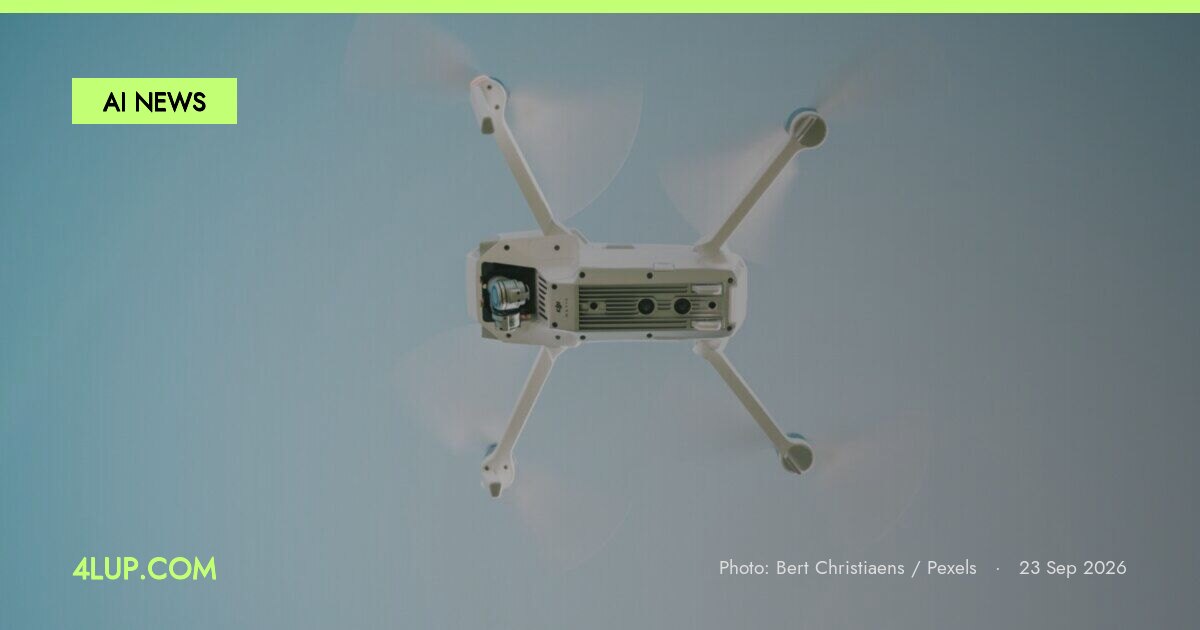
A new research paper posted to arXiv cs.AI titled Skytopia explores monocular drone navigation using action-conditioned latent world models. Navigating an unseen environment using only a single forward-facing camera presents significant challenges, primarily because a monocular setup provides very few reliable cues for depth and scale. Traditional world model approaches attempt to solve this by modeling how observations evolve under specific actions, typically executing predictions at deployment and feeding them back into action generation at every control step. The Skytopia research argues that an autonomous policy actually requires the underlying representation needed to produce predictions, rather than the prediction itself, noting that in actual flight, the executed action accounts for almost all of the visual change between observations.
Understanding Latent World Models in Robotics
World models have become a prominent area of research in machine learning and robotics. By internalizing the dynamics of an environment, an agent can theoretically plan future actions without relying entirely on reactive control. In aerial robotics, processing raw visual feeds from a single camera to estimate 3D structure and distance is computationally expensive and prone to error. Utilizing latent representations—compact internal encodings of environmental states—allows a drone to process visual data more efficiently. The core insight behind Skytopia centers on shifting the utility of these models away from step-by-step prediction generation and toward utilizing their internal representations for more effective policy learning during navigation tasks.
Unknowns and Future Evaluation
Despite the release of the research paper, the announcement did not specify the exact neural network architectures used, the specific hardware platform required for onboard inference, or whether the code and models will be released publicly. It remains unclear how well this approach scales to highly dynamic, cluttered, or outdoor environments with changing lighting conditions. Future updates from the researchers may provide empirical performance benchmarks against existing navigation baselines.
Further details regarding the computational overhead and physical flight testing parameters will need to be released to determine the practical applicability of the Skytopia framework for real-world autonomous drones.
Lead image: Bert Christiaens / Pexels